Crawl Space Flooding in Peachtree Corners: Causes and Solutions
Most Peachtree Corners homeowners don’t inspect their crawl space until something goes wrong — a musty smell in the living room, soft spots in the floor, or water stains on joists visible from an access hatch. By that point, what might have been a simple drying project has often become a combined drying-plus-mold-remediation project. In this post, we cover why crawl space flooding is so common in Gwinnett County, what it damages, and how to decide between spot drying and full encapsulation.
Wet Crawl Space in Peachtree Corners, GA?
Free crawl space assessment — we identify the moisture source and provide a written estimate. Call (877) 698-1311.
Why Crawl Space Flooding Is So Common in Peachtree Corners
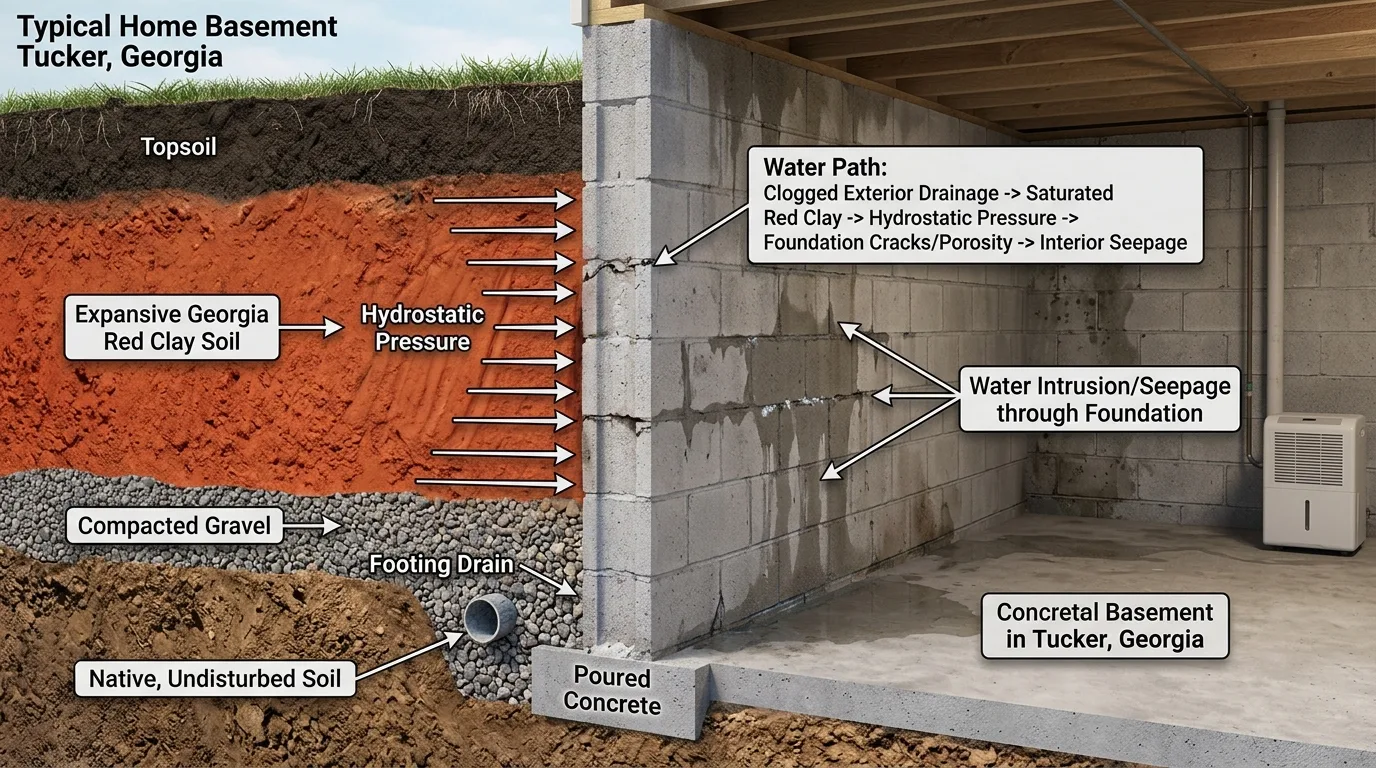
The answer begins with Gwinnett County’s geology. Peachtree Corners sits on a bed of red clay soils that have very low permeability — they absorb water slowly and release it even more slowly. When Peachtree Corners receives significant rainfall (and at 52+ inches annually, it receives a great deal), the clay soil becomes saturated quickly and converts most additional rainfall into surface runoff. On the sloped lots characteristic of neighborhoods like Amberfield and Spalding Corners, this runoff flows downhill toward the lowest point: the foundation perimeter.
From the foundation perimeter, water finds any available path into the crawl space — foundation vents that weren’t sealed, gaps around plumbing penetrations, minor cracks in the foundation wall, or simply direct soil contact where the vapor barrier has failed or never existed. Once inside, the water saturates the soil floor, wets insulation hanging from floor joists, and begins absorbing into the framing members from below.
The design of the crawl spaces in most Peachtree Corners homes built between the 1970s and 1990s makes this problem worse. These homes were built with open foundation vents — the then-standard approach to crawl space ventilation that has since been recognized as actively harmful in humid climates. In summer, when outdoor dewpoint temperatures exceed the temperature of the crawl space surfaces, opening those vents draws in humid air that immediately condenses on the cooler framing and soil, adding moisture rather than removing it.
What Crawl Space Flooding Damages
Insulation: Fiberglass batt insulation hung from floor joist bays absorbs water readily and holds it against the framing members for extended periods. Wet fiberglass insulation loses its R-value, supports mold growth, and eventually detaches and falls to the crawl space floor in sodden masses. It must be removed when wet — it cannot be dried in place effectively.
Floor joists and rim joists: Wood framing in the crawl space absorbs moisture when continuously exposed. As moisture content in the wood exceeds approximately 19%, the conditions for wood rot and wood-decay fungus (often mistaken for mold) are established. Wood rot progresses slowly but structurally — compromised floor joists eventually produce soft, springy floors in the living space above.
Subfloor sheathing: The OSB or plywood sheathing forming the floor deck absorbs moisture from below, causing it to swell, delaminate, and soften. Subfloor damage is the most expensive crawl space moisture consequence to repair because it requires removing and replacing finished flooring above to access the subfloor structure.
Mold on framing: The combination of moisture, organic material (wood), and temperatures above 40°F creates ideal mold conditions. Mold on crawl space framing members is extremely common in Peachtree Corners homes that have experienced repeated seasonal moisture without intervention.
Crawl Space Moisture Damage in Peachtree Corners?
IICRC-certified drying and encapsulation — serving Gwinnett County. Free assessment, call (877) 698-1311.
Crawl Space Drying vs. Encapsulation: How to Choose
When crawl space drying alone is appropriate: A single flooding event from an identifiable source — a plumbing failure, a storm event that entered through a specific opening — that has not recurred, in a crawl space that was otherwise dry and in good condition. In this scenario, extracting the standing water, drying the framing and soil to target moisture content, and repairing the specific entry point is a complete solution.
When encapsulation is the better choice: Properties on sloped lots with persistent seasonal moisture pressure from clay soil; homes in neighborhoods like Amberfield or Chattahoochee Station that have experienced crawl space moisture in multiple consecutive years; any crawl space where mold on framing members has been remediated but the underlying drainage problem cannot be fully resolved. Encapsulation installs a sealed vapor barrier across the crawl space floor and against foundation walls, eliminating soil moisture vapor as a source, and typically includes a crawl space dehumidifier to maintain relative humidity below 60% regardless of exterior conditions.
The decision comes down to whether the moisture source can be eliminated. If a specific entry point can be sealed and the drainage can be corrected, drying is sufficient. If the moisture source is hydrostatic pressure from saturated clay soil against the foundation — a condition inherent to the property’s topography — encapsulation is the more cost-effective long-term solution.
What the Crawl Space Drying Process Involves
Crawl space drying begins with an entry assessment: moisture readings at multiple locations, identification of the water entry path, and documentation of any damaged materials. Standing water is extracted first if present. Wet insulation is removed and bagged — it cannot be dried in place. If mold is present on framing, IICRC S520 remediation is performed as part of the project before drying begins.
Commercial drying equipment is positioned in the crawl space — typically axial air movers that create airflow across framing surfaces and LGR dehumidifiers sized for the crawl space volume. In a Peachtree Corners summer, the ambient humidity outside the crawl space exceeds the dehumidifier target humidity, which means the crawl space must be isolated from exterior air during drying. Foundation vents are temporarily sealed, and the space is treated as a closed drying chamber.
Daily moisture readings confirm drying progress. The drying phase closes when all monitored framing members reach target moisture content — typically 15–19% for dimensional lumber.
Frequently Asked Questions
How do I know if my Peachtree Corners crawl space is flooding?
The most common indicators are: a musty or earthy odor in first-floor rooms that worsens after rain, soft or springy floor sections, visible mold or wet insulation through the access hatch, increased indoor humidity above 60% despite normal HVAC operation, and unexplained pest activity (wood-boring insects are attracted to moisture-damaged framing). Many crawl space moisture problems in Gwinnett County are discovered during a home inspection or during an unrelated repair project that required crawl space access.
How much does crawl space drying cost in Peachtree Corners?
Crawl space drying in Peachtree Corners typically ranges from $1,500 to $6,000 for extraction, insulation removal, and structural drying. Full encapsulation — sealed vapor barrier plus crawl space dehumidifier — adds $3,000–$8,000 depending on the crawl space footprint. For high-risk properties on sloped lots with clay soil, encapsulation is typically more cost-effective than repeated annual drying cycles.
Does homeowners’ insurance cover crawl space flooding in Gwinnett County?
Coverage depends on the cause. Crawl space flooding from a sudden internal event — a plumbing failure, for example — is typically covered. Crawl space moisture from gradual water intrusion through soil, without a specific sudden and accidental event, is typically not covered under standard homeowners’ policies. Review your policy and consult your insurer if you’re uncertain about coverage before assuming either way.
Crawl Space Drying and Encapsulation for Peachtree Corners Homes
Call (877) 698-1311 for a free crawl space assessment. IICRC certified, all insurance carriers, Gwinnett County-wide response.
Related: